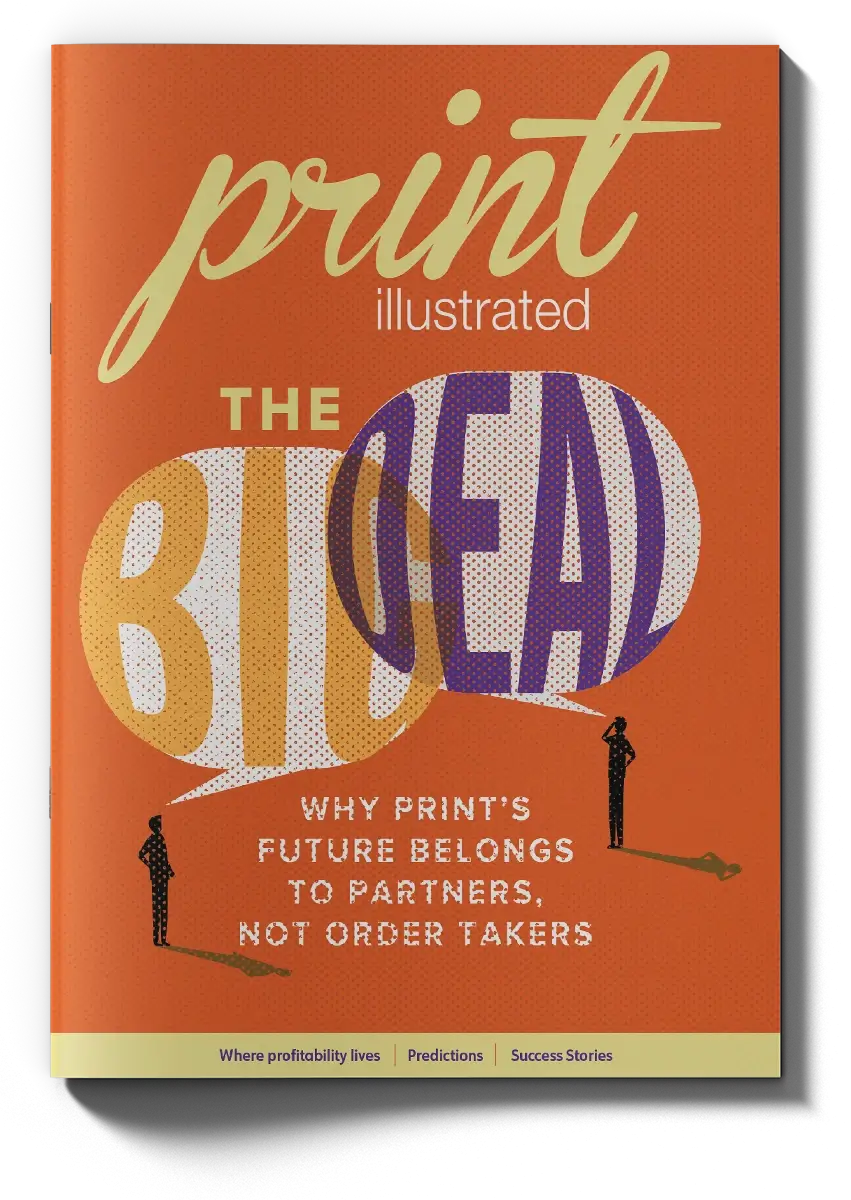
The future of print is being shaped in conversations. Not transactional exchanges built around specs and pricing, but deeper dialogues that uncover inefficiencies, expose friction and ultimately redefine what value looks like. As margins tighten and communication ecosystems grow more complex, these types of conversations are becoming the real differentiation point.
As the landscape plays out, the printers staying focused on order taking are getting pulled into price. The ones that lead with questions—digging into workflows, challenges and long-term goals—are positioning themselves as partners embedded in the business itself.
Jake Wallace, VP of Wallace Graphics in Duluth, Georgia, sees that shift play out in real time. “We don’t typically try to add complexity for the sake of it. In fact, our goal is usually the opposite. Where we’ve seen the biggest impact is in doing more upfront work to simplify things long-term.”
This mindset changes where the work begins. Instead of reacting to incoming jobs, Wallace and his team focus on what happens before a file ever hits production. In repeat programs, that often means building clean data structures, organizing artwork libraries and creating clear agreements around how information flows between teams.
“Success in a sale is more than either party ‘winning.’ In a consultative approach, a deeper issue is resolved. There is a shared belief that a longer-term solution and resulting partnership has been established.“
– Mark Phillips, Chief Commercial Officer, SumnerOne
“While that front-end setup can feel more demanding initially, the ‘aha’ moment for clients is realizing that it dramatically reduces friction going forward,” Wallace says. “Jobs become automated, turnaround times shrink, errors drop, and internal effort on their side is reduced. They move from managing individual print orders to running a scalable, repeatable program.”
In other words, the conversation shifts from output to infrastructure. Wallace says the foundation of that shift is not expertise alone—it is curiosity. “This is one of the hardest parts of consultative selling—and also the most important. There isn’t a universal set of questions that works for every company, because no two organizations operate the same way.”
Some clients arrive with clearly defined challenges, while others have never considered that a print partner could influence anything beyond production. “Our approach is less about a fixed script and more about asking the right questions in the right sequence to get to the root of what makes their job harder than it needs to be,” Wallace says. “The goal is always to uncover where we can remove friction, save time, reduce risk or simplify their internal processes—not just quote a job.”
That evolution is also changing how print companies operate internally. Sales is no longer an individual effort—it is a coordinated one. “It’s become much more of a team-selling environment,” Wallace says. “Our sales reps are highly knowledgeable, but no one can be an expert in everything. In the past, print sales often centered on finding the next order. Today, especially with enterprise accounts, it’s about assembling the right internal team to solve real business problems collaboratively.”

Shaping Your Conversations
Mark Phillips has seen what happens when companies fail to make that shift. As CCO at SumnerOne in Saint Louis, Missouri, he continues to encounter organizations that walk into meetings ready to quote, but not prepared to listen. “When I am meeting with a prospective new client, I want the questions to open up a conversation, not feel like an audit or inquiry.”
The difference shows up in the types of questions being asked. Instead of focusing on quantities or turnaround times, Phillips encourages his team to explore where friction lives inside a client’s operation:
Where does print slow things down?
How does that impact the end user?
What changes are coming that will put pressure on communication workflows?
When issues arise, are they rooted in process, technology or ownership?
“Sales need to be attentive to what a customer is truly saying and be able to ask better second and third level questions. That is the beginning of what ‘success’ looks like.“
– Jake Wallace, VP, Wallace Graphics
These are not pricing conversations. They are diagnostic ones. “Success in a sale is more than either party ‘winning.’ In a consultative approach, a deeper issue is resolved. There is a shared belief that a longer-term solution and resulting partnership has been established.”
That kind of outcome starts with clarity—and with discipline. “For the selling party, it starts with a true understanding of your company’s value proposition and a focus on listening,” Phillips says. “Sales need to be attentive to what a customer is truly saying and be able to ask better second and third level questions. That is the beginning of what success looks like.”
In too many cases, the challenge is that the market still defaults to price. Phillips says print will likely remain a space where price-per-piece comparisons dominate many buying decisions. But companies that want to break out of that cycle have to reframe how they show value.

“To move away from the commodity pricing objection, a company needs to understand its total value proposition to a client and have confidence in the impact it has long-term,” Phillips says. “While not every opportunity may be a high-value piece, each order builds the trust needed when a conversation reverts to price exclusively.”
Trust here is not abstract—it is built through consistency. Phillips pushes for a steady rhythm: regular business reviews, ongoing communication and engagement across multiple levels. Alignment is not created in a single meeting. It is sustained over time.
“In the end, clients tend to have a ‘What have you done for me recently?’ mentality,” Phillips says. “Building a cadence of communication that reinforces shared success and alignment creates a deeper partnership and stronger collaboration.”
As the print world rolls forward, the winners will not be the ones that respond the fastest, but the ones that understand the most. As Wallace and Phillips agree, better conversations do not just close deals—they build systems, strengthen relationships and create value that lasts.
5 Ways Transactional and Consultative Selling Differ
1. Starting point – Transactional begins with specs and price. Consultative begins with questions about friction and goals.
2. Definition of success – Transactional wins the bid. Consultative solves a business problem.
3. Source of value – Transactional competes on cost and speed. Consultative competes on efficiency, risk reduction and long-term impact.
4. Relationship model – Transactional is job-by-job. Consultative builds repeatable programs.
5. Team approach – Transactional relies on a rep. Consultative engages cross-functional expertise.
Source: Jake Wallace, Wallace Graphics; Mark Phillips, SumnerOne